
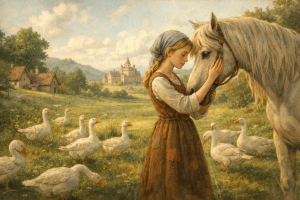
Illustration from The Goose Girl, a Grimm fairy tale about a princess, her loyal horse Falada, and a journey of loss and truth.
This is a traditional tale collected by the Brothers Grimm.
The story is presented here in its original form.
A king and queen had a daughter who was exceedingly beautiful, but she was so proud and haughty that no suitor was good enough for her. At last, however, a prince presented himself who pleased her parents, and the wedding was arranged.
When the time came for her to travel to her bridegroom’s country, the queen packed up many costly vessels of gold and silver, also cups and jewels, in short everything which appertains to a royal dowry; for she loved her child with all her heart. She also sent her waiting-maid with her, who was to ride with the princess and hand her over to the bridegroom, and each had a horse for the journey, but the princess’s horse was called Falada and could speak.
When the hour of departure had come, the old queen went into her bedroom, took a small knife, and cut her finger till it bled. Then she held a white handkerchief to it, into which she let three drops of blood fall, gave it to her daughter, and said, “Dear child, preserve this carefully; it will be of service to you on your way.”
So they took a sorrowful leave of one another, the princess put the piece of cloth in her bosom, mounted her horse, and went away to her bridegroom’s kingdom. After she had ridden for a while, she felt a burning thirst, and said to her waiting-maid, “Alight, and take my cup which thou hast brought with thee for me, and get me some water from the stream, for I should like to drink.”
“If you are thirsty,” said the waiting-maid, “get off your horse yourself, lie down by the water, and drink; I do not choose to be your servant.” Then, in her great thirst, the princess alighted, bent over the flowing water, and drank, and was not allowed to drink out of the golden cup. Then she said, “Ah, heaven!” and the three drops of blood answered, “If thy mother knew this, her heart would break.”
But the princess was humble, said nothing, and mounted her horse again. They rode some miles further, but the day was warm, the sun beat down, and she was soon thirsty once more. When they came to a stream of water, she again cried, “Alight, and give me some water to drink.”
“If you are thirsty, drink yourself,” said the waiting-maid, “I do not choose to be your servant.” Then the princess alighted in her great thirst, lay down by the water, wept, and said, “Ah, heaven!” and the drops of blood again replied, “If thy mother knew this, her heart would break.”
And as she thus drank and leaned over the stream, the handkerchief with the three drops of blood fell out of her bosom, and floated away with the water without her observing it, on account of her trouble. The waiting-maid, however, had seen it, and she rejoiced to have power over the bride, for since the princess had lost the drops of blood, she had become weak and powerless.
When, therefore, she wanted to mount her horse again, which was called Falada, the waiting-maid said, “Falada is more suitable for me, and my nag will do for thee,” and the princess had to be content with that. Then the waiting-maid commanded her with many hard words to take off her royal apparel and put on her own shabby clothes, and at last she was obliged to swear under the clear sky that she would not tell anyone at the royal court what had happened. If she had not taken this oath, she would have been killed on the spot. But Falada saw all this, and observed it well.
When they arrived at the royal court, there was great rejoicing over the beautiful bride, and the prince ran to meet her, lifted the waiting-maid from her horse, and thought she was his true bride. She was led upstairs, but the real princess was left standing below. Then the old king looked out of the window and saw her standing in the courtyard, and noticed how delicate and beautiful she was, and instantly went to the royal chamber and asked the bride about the girl whom she had brought with her, who she was, and what she was doing there.
“I picked her up on the way, and brought her with me for company; give the girl something to work at, that she may not stand idle.” But the old king had no work for her, and knew of none, so he said, “I have a little boy who tends the geese; she can help him.” The boy was called Conrad, and the true bride had to help him tend the geese.
Soon afterwards the false bride said to the young king, “Dearest husband, I beg you to do me a favor.”
He answered, “I will do so most willingly.”
“Then send for the knacker, and have the head of the horse on which I rode here cut off, for it annoyed me on the way.” In reality, she was afraid that the horse might speak and tell how she had behaved to the princess. This was done, and the faithful Falada was doomed to die.
When the true princess heard of it, she secretly promised the knacker a piece of gold if he would perform a small service for her. There was a great dark gateway in the city, through which she had to pass every morning and evening with the geese, and she begged him to nail up Falada’s head on it, so that she might see it again more than once. The knacker’s man promised to do that, and cut off the head and nailed it fast beneath the dark gateway.
Early in the morning, when she and Conrad drove out their geese through the gate, she said in passing:
“O Falada, there thou hangest!”
Then the head answered:
“O queen, how ill you fare!
If this your mother knew,
Her heart would break in two.”
Then they went still further out of the city, and drove the geese into the country. When they had arrived at the meadow, she sat down and unbound her hair, which was pure gold, and Conrad saw it and delighted in its brightness, and wanted to pluck some of it out. Then she said:
“Blow, wind, blow,
Take Conrad’s hat away from him,
And make him chase it here and there,
Until I have braided all my hair
And bound it up again.”
And there came such a strong wind that it blew Conrad’s hat far away across the country, and he had to run after it, and when he came back she had finished combing and putting up her hair again, and he could not get any of it. Conrad was angry at this, and would not speak to her. And thus they watched the geese until the evening, and then went home.
The next morning, as they were driving the geese through the dark gateway, the maiden said:
“O Falada, there thou hangest!”
Falada answered:
“O queen, how ill you fare!
If this your mother knew,
Her heart would break in two.”
And in the meadow she again sat down and began to comb out her hair, and Conrad ran up and wanted to take hold of it. Then she said in haste:
“Blow, wind, blow,
Take Conrad’s hat away from him,
And make him chase it here and there,
Until I have braided all my hair
And bound it up again.”
Then the wind came and blew his hat away, and Conrad had to run far after it, and when he came back her hair was all put up again, and he could not get any of it. So they tended the geese till evening.
But Conrad went to the old king and said, “I will no longer tend the geese with that girl.”
“Why not?” asked the old king.
“Oh, because she annoys me the whole day long.”
Then the old king commanded him to relate what it was that she did to him. And Conrad said, “In the morning when we pass beneath the dark gateway with the flock, there is a sorry horse’s head on the wall, and she says to it:
‘O Falada, there thou hangest!’
And the head replies:
‘O queen, how ill you fare!
If this your mother knew,
Her heart would break in two.’”
And Conrad went on to relate what happened out in the goose field, and how he had to chase his hat there.
The old king commanded him to go out again the next day, and when morning came, he placed himself behind the dark gateway, and heard how the maiden spoke to the head of Falada, and then he too went into the country, and hid himself in a bush in the meadow. There he soon saw with his own eyes the goose-girl and the goose-boy driving the flock, and after a while she sat down and let down her hair, which shone like pure gold. Soon she said:
“Blow, wind, blow,
Take Conrad’s hat away from him…”
Then came a gust of wind and carried away Conrad’s hat, so that he had to run a long way off, while the maiden quietly combed and braided her hair, all of which the king observed.
Then he went away quite unnoticed, and when the goose-girl came home, he called her aside, and asked why she did all these things. “I may not tell you that, and I dare not complain to any human being, for I have sworn not to do so, or I should lose my life.” He urged her, but he could get nothing out of her.
Then said he, “If you will not tell me anything, tell your sorrows to the iron stove there,” and he went away. Then she crept into the iron stove, and began to weep and lament, and poured out her whole heart, and said, “Here am I forsaken by all the world, and yet I am a king’s daughter, and a false waiting-maid has by force brought me to such a pass that I have been compelled to put off my royal apparel, and she has taken my place with my bridegroom, and I am forced to do menial service as a goose-girl. If my mother knew that, her heart would break.”
The old king, however, was standing outside by the pipe of the stove, and was listening to what she said, and heard it all. Then he came back again, and bade her come out, and royal garments were placed on her, and it was marvellous how beautiful she was.
The old king summoned his son, and revealed to him that he had a false bride, who was only a waiting-maid, but that the true bride stood there. The young king rejoiced when he saw her beauty and youth, and a great feast was prepared, to which all the people and all good friends were invited.
At the head of the table sat the bridegroom, with the true bride on one side, and the waiting-maid on the other, but the waiting-maid was blinded, and did not recognize the princess in her dazzling attire. When they had eaten and drunk, and were merry, the old king put a riddle to the waiting-maid: he asked what a person deserved who had behaved in such and such a way, and at the same time he related the whole story, and asked, “What does such a one deserve?”
The false bride said, “She deserves no better fate than to be stripped naked, and put in a barrel studded within with sharp nails, and two white horses should be harnessed to it, which will drag her along through one street after another, till she is dead.”
“It is you,” said the old king, “and you have pronounced your own sentence,” and when the sentence had been carried out, the young king married his true bride, and they reigned over their kingdom in peace and happiness.