

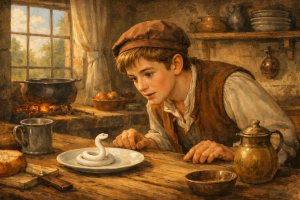
Illustration from The White Snake, a traditional Grimm fairy tale about a servant who gains the gift of understanding animals.
This is a traditional tale collected by the Brothers Grimm.
The story is presented here in its original form.
A certain king had a custom that every day, after dinner, and when the table was cleared, a trusty servant had to bring him one more dish. This dish, however, was covered, and even the servant did not know what was in it, neither did anyone know, for the king never took off the cover to eat of it until he was quite alone.
This had gone on for a long time, when the servant, who took away the dish, was seized with such curiosity that he could not overcome it. So one day he carried the dish into his room, locked the door carefully, lifted up the cover, and saw a white snake lying on it. But when he saw it he could not deny himself the pleasure of tasting it, so he cut off a little piece and put it into his mouth.
Scarcely had it touched his tongue than he heard a strange whispering of delicate voices outside his window. He went and listened, and then noticed that it was the sparrows who were chattering together, and telling one another of all kinds of things which they had seen in the fields and woods. Eating the snake had given him power to understand the language of animals.
Now it happened that on this very day the queen lost her most beautiful ring, and suspicion fell upon this trusty servant, who was allowed to go everywhere, and even into the royal apartments. The king ordered him to be brought before him, and threatened him with the greatest punishment if by the morrow he did not bring forth the thief. The servant protested his innocence, but it was of no avail.
Full of anxiety, he went down into the courtyard and considered what he should do. There the ducks were sitting quietly together by a brook, and were resting themselves and making their feathers smooth with their bills. They were chattering together, and the servant stood listening. They were telling one another where they had been waddling about all the morning, and what good food they had found; and one said in a pitiful tone, “Something lies heavy on my stomach; I swallowed in haste a ring which lay under the queen’s window.”
The servant at once seized her by the neck, carried her to the kitchen, and said to the cook, “Here is a fine duck; pray kill it.”
“Yes,” said the cook, weighing it in her hand, “she has spared no trouble to fatten herself, and has been waiting a long time to be roasted.” So she cut off her head, and when she was opened for dressing, the queen’s ring was found inside her.
The servant could now easily prove his innocence; but the king, to make him amends for the wrong, and also to show his favour, permitted him to ask a reward, and promised him the highest office at court if he would accept it.
The servant, however, refused everything, and only asked for a horse and a sum of money, as he had a mind to travel and see the world. When his request was granted, he set out on his way, and after a while came to a pond, where he saw three fishes caught in the reeds, and gasping for water. Now although it is said that fishes are dumb, he heard them lamenting that they must perish so miserably, and as he had a kind heart, he got off his horse and put the three prisoners back into the water. They leapt for joy, put out their heads, and cried to him, “We will remember you and repay you for saving us.”
He rode on, and after a while it seemed to him as if he heard a voice on the sand at his feet. He listened, and heard an ant-king complaining, “Why cannot folks, with their clumsy beasts, keep off our bodies? That stupid horse, with his heavy hoofs, is treading down my people without mercy!” So he turned on to a side path, and the ant-king cried out to him, “We will remember you—one good turn deserves another!”
His road led him through a wood, where he saw a father raven and mother raven standing by their nest, and throwing out their young ones. “Be off with you, you gallows-birds!” cried they; “we cannot feed you any longer; you are big enough, and can provide for yourselves.” But the poor young ravens lay on the ground, fluttering, and crying, “Oh, what helpless chicks we are! we must shift for ourselves, and yet we cannot fly! what can we do but lie here and starve?”
Then the good-hearted servant alighted, killed his horse with his sword, and gave it to the young ravens for food. They came hopping up, satisfied their hunger, and cried, “We will remember you—one good turn deserves another!”
He had now to use his own legs, and when he had walked a long way, he came to a great city. There was a great noise and crowd in the streets, and a man rode up on horseback and proclaimed that the king’s daughter sought a husband; but whoever wooed her must perform a difficult task, and if he did not succeed, he would forfeit his life. Many had already made the attempt, but in vain; nevertheless, when the young man saw the princess, he was so overcome by her great beauty that he forgot all danger, went before the king, and declared himself a suitor.
So he was led out to the sea, and a gold ring was thrown into it before his eyes. Then the king ordered him to fetch this ring up from the bottom of the sea, and added, “If you come up again without it, you will be thrown in again and again until you perish amid the waves.” All the people pitied the handsome youth; then they went away, leaving him alone by the sea.
He stood on the shore and considered what he should do, when suddenly he saw three fishes swimming towards him, and they were the very fishes whose lives he had saved. The one in the middle held a mussel in its mouth, which it laid on the shore at the young man’s feet. When he took it up and opened it, there lay the gold ring inside.
Full of joy, he took it to the king, and expected that he would grant him the promised reward. But the proud princess, when she heard this, disdained him, and required him to perform another task. She went down into the garden, and strewed with her own hands ten sacks full of millet-seed on the grass. Then she said, “Tomorrow morning, before sunrise, these must be picked up, and not a single grain be wanting.”
The young man sat down in the garden and considered how it was possible to perform this task; but he could think of nothing, and sat there sorrowfully awaiting the break of day, when he would be led to death. But as soon as the first rays of the sun shone into the garden, he saw the ten sacks standing all filled, and not a single grain was missing. The ant-king had come in the night with thousands and thousands of ants, and the grateful creatures had by great industry picked up all the millet-seed and gathered it into the sacks.
The princess herself came into the garden and saw with astonishment that the young man had done what had been required of him; but she could not yet subdue her proud heart, and said, “Although he has performed both the tasks, he shall not be my husband until he has brought me an apple from the Tree of Life.”
The young man did not know where the Tree of Life stood, but he set out, and would have gone on for ever, as long as his legs would carry him, though he had no hope of finding it. After he had journeyed through three kingdoms, he came one evening to a wood, and lay down beneath a tree to sleep. But he heard a rustling in the branches, and a golden apple fell into his hand. At the same time three ravens flew down to him, perched themselves upon his knee, and said, “We are the three young ravens whom you saved from starving; when we had grown big, and heard that you were seeking the golden apple, we flew over the sea to the end of the world, where the Tree of Life stands, and have brought you the apple.”
Then the young man, full of joy, set out homewards, and brought the golden apple to the beautiful princess, who now had no more excuses left to make. They cut the apple of life in two, and ate it together; and then her heart became full of love for him, and they lived in undisturbed happiness to a great age.